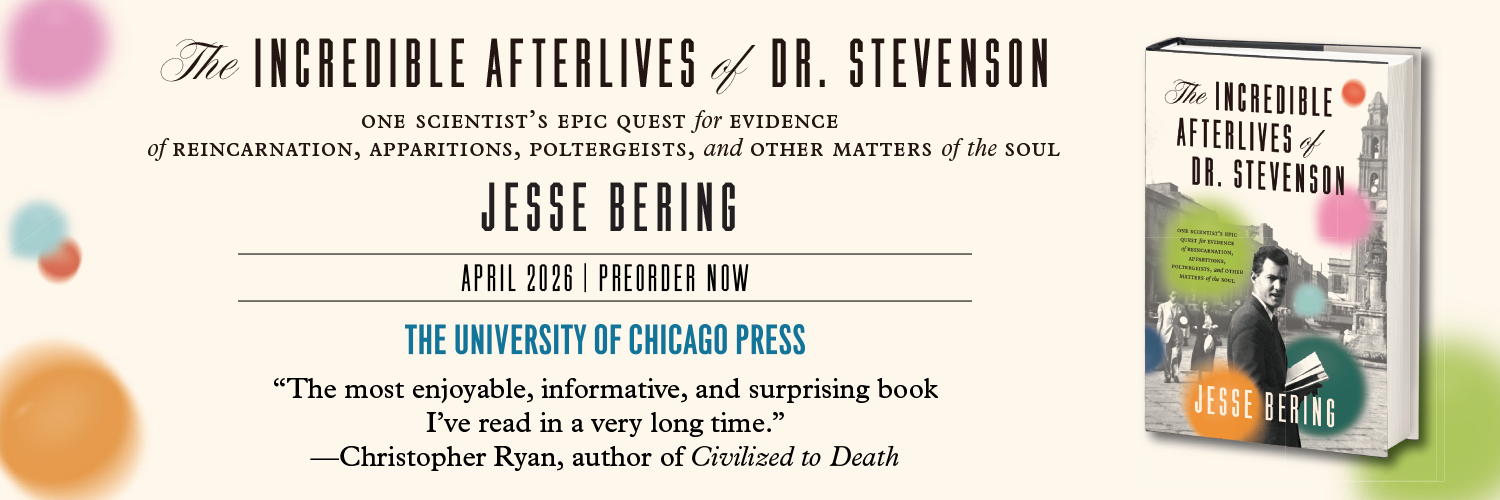
The Incredible Afterlives of Dr. Stevenson

One Scientist's Epic Quest for Evidence of Reincarnation, Apparitions, Poltergeists, and Other Matters of the Soul

The untold story of an iconoclastic scientist: a psychiatrist who dedicated his career to documenting consciousness after death.

Jesse Bering

Writer, psychologist, science communicator

From God to sex to suicide to the afterlife, Jesse uses humor and science to explore, at the deepest levels, what it means to be—and to think—human.

Books

About Jesse

A research psychologist and the author of several acclaimed popular science books, Jesse and his work have been featured on numerous documentaries, television shows and radio programmes, including ‘Through the Wormhole with Morgan Freeman’, ‘Conan’, ‘Chelsea Lately’, ‘Q&A’ (Australia), NPR’s ‘All Things Considered’ and the BBC. He has written for Scientific American, Slate, Guardian, The New York Times, Discover, Chicago Tribune, New Republic, Vice and many others. He currently writes the weekly sex and science column LE BON COUP DU DIMANCHE SOIR for the French magazine Le Point.

Jesse is Professor of Psychology and Head of the Science Communication Programme at the University of Otago in New Zealand. He lives on the Otago Peninsula with his partner Juan and their  border terriers, Hanno and Kora.

read more

"I'm not surprised that a book on suicide would be very personal, but I didn’t expect it to be so damn funny. It's also engaging, thoughtful, and sensitive--although Bering is certainly irreverent, there is a real appreciation of how painful and difficult this topic can be. This is a book for scholars and for a general audience, but it is also entirely suitable for people whose lives have been touched by the suicide of someone they loved.”

Paul Bloom, author of Against Empathy

"Excellent in its entirety, woven of Bering’s rare tapestry of scientific rigor and a powerful, articulate social point of view.”

Brain Pickings

“Against a colorful backdrop of science, history, and psychology, Bering calls on human society to stop judging people’s sexual preferences based on a personal belief about what’s normal or natural, instead asking what is harmful. [He] throws a bucket of ice-cold water on topics that often become overheated by the fires of morality, religion, and politics.”

The Scientist

Cookie Consent

By clicking “Accept”, you agree to the storing of cookies on your device to enhance site navigation, analyze site usage, and assist in our marketing efforts. View our Privacy Policy for more information.